Synastry Chart Calculator: Are We Compatible?
Enter both birthdays. You get what draws you together, where you may clash, and how to handle it, in plain English.
- Free
- No sign-up
- Their birth time is optional
What is a synastry chart?
Enter both birth dates in the month, day and year boxes and press the button. The synastry chart opens on a results page with every planet connection between the two charts, sorted Easy, Tense or Strong either way. Adding birth time and birthplace sharpens the Moon and unlocks rising signs and houses.
Attraction
Venus and Mars contacts: what pulls you together.
Talking
Mercury contacts: how easily you understand each other.
Staying
Saturn contacts: what makes the bond last, or feel heavy.

Common questions
Which free synastry chart calculator should I use?
Use one that lists every aspect with its orb, explains each in plain words and costs nothing to read. This calculator does all three: it shows each connection with a one-line reading, scores out of 100, a two-ring wheel, house overlays and a composite chart, with no account or email.
Can a synastry chart tell me if we are romantically compatible?
It shows where two charts connect easily, where they pull against each other and where they merge, and scores attraction, talking, feeling and staying. Those results are a map for reflection and conversation, not a verdict on whether a relationship will work.
Can I get a synastry chart without a birth time?
Yes. Tick the unknown-time box and the chart is calculated from the two dates alone, with the planet connections listed as usual. Moon connections count at half weight in that case. Adding a birth time later brings in rising signs and houses.
Is the synastry chart calculator free?
Yes. Every calculation and the one-line reading of each aspect are free, with no account and no email. Signing in is optional and only matters if you want one reading saved to your account. A longer written report is optional and paid once.
Is my birth data kept private?
The calculation runs in your browser, and birth details stay on your device unless you save them to your account or buy a report; both keep them on our servers. You can remove a saved reading from the results page. Birth dates are never placed in the page address.
Which house system does the synastry chart use?
Houses default to Placidus, and Whole Sign is available as an option on the results page. The zodiac is Western tropical. Time zone and daylight saving are worked out from the birthplace and date, so you never choose them.
Can I use it for friends or family?
Yes. The results switch between Couple and Friends or family. If either person is under 18, only Friends or family is available. The form asks for no names or genders, just the dates and, optionally, time and place.
What is the difference between synastry and a composite chart?
Synastry lays two birth charts over each other and lists the connections between them. A composite chart combines the two into a single chart for the relationship itself. Both appear on the results page, so you can compare the two views.
What counts as the strongest connection in a synastry chart?
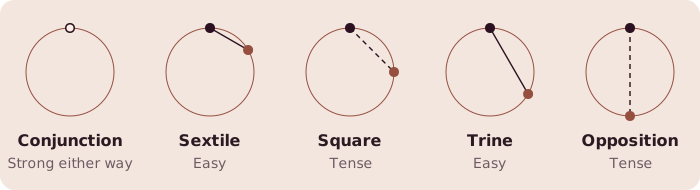
The strongest section shows the three links that add most to your scores, plus the one that takes the most work. Every aspect in the full list shows its orb, the gap in degrees between two planets. Conjunctions are marked Strong either way because they can feel easy or tense depending on the planets involved.
How to use it
- Enter the first birth date Type the month, day and year for the first person. The cursor moves to the next box once one is full, so you can keep typing without clicking.
- Enter the second birth date Fill in the same boxes for the second person. Add a birth time and a birthplace picked from the list if you know them, or tick the box for an unknown time.
- Press the button The chart is calculated in your browser and the results page opens. Switch between Couple and Friends or family to match the relationship you are looking at.
- Read the connections Start with the counts of Easy, Tense and Strong either way connections, then open the strongest ones, the four scores, the full aspect list, the house overlays and the composite chart.
Who uses a synastry chart, and for what
Most people arrive with one particular person in mind. Someone a few months into dating wants words for why conversations flow on some evenings and stall on others. A pair of siblings sorting out a family business wants to see why they argue about the same topics every time. Two friends planning to share an apartment want a light, curious way to talk about habits before the lease is signed.
A parent can also run a chart with a teenager, and a coworker pair can run one out of plain interest. The chart gives each of these pairs a shared page to point at, which is often easier than describing a feeling out loud.
Gather the details before you start
A few minutes of preparation makes the chart worth reading. Look for birth dates on an official document rather than relying on memory, since a swapped month and day gives a completely different chart. If you want the houses and rising signs, find the birth time on a birth certificate or ask a parent. Hospital paperwork often lists it to the minute.
For the place, use the town where the birth happened, not the town where the person grew up. If a parent remembers “around lunchtime” but not the exact minute, it is often wiser to tick the unknown-time box than to guess. A guessed time can shift the houses without anyone noticing.
Read the results in a good order
The page holds a lot, so a sequence helps.
Start with the counts
The totals of Easy, Tense and Strong either way connections give the overall texture in a few seconds. A chart with many Easy connections tends to feel comfortable. A chart heavy with Tense ones tends to feel lively and demanding. Neither is better; each describes a different kind of closeness.
Move to the strongest connections
The strongest connections come first because they carry the most weight. Read the one-line reading of each, then ask whether it matches something you have already noticed. Recognition is the useful part. If a reading rings true, it gives you a name for a pattern. If it does not, set it aside.
Look at the four scores
The scores for attraction, talking, feeling and staying are separate on purpose. A pair can score high on talking and lower on feeling, which often describes close friends well. Compare the four numbers with each other instead of judging each against a perfect 100.
Finish with the full list and the wheel
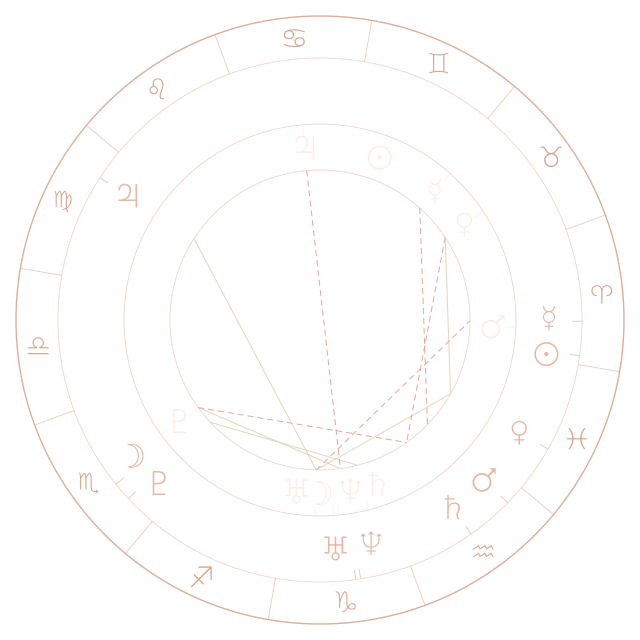
The complete aspect list is the reference section. Go back to it when a particular planet comes up in conversation, and use the orb to see how close the connection is. The smaller the orb, the more the connection stands out. The two-ring wheel puts one chart inside the other, so clusters of connections are easy to spot at a glance.
Use the result to start a conversation
A chart works best when both people look at it together. Pick one Easy connection and one Tense connection and read both lines aloud. Ask each other where the pattern shows up in daily life. A couple might find that the Easy connection describes how they plan trips and the Tense one describes how they handle money. A pair of friends might recognize the Tense one as the reason they sometimes talk past each other when tired.
Tense does not mean bad. Squares and oppositions mark friction, and friction can produce energy, motivation and honest disagreement. Treat each one as a topic that deserves attention, not as a warning.
Make sense of house overlays and the composite chart
House overlays show where one person’s planets fall in the other’s houses, which is a way of seeing which area of life a person touches for the other. Read the overlays one person at a time, then swap, and note whether the pattern is the same in both directions.
The composite chart combines the two charts into a single chart for the relationship itself. Look at it when the question is less “how do we affect each other?” and more “what is this partnership like as a whole?” Comparing the composite chart with the connections between the two charts often shows the same themes from two sides.
Compare more than one pair
Running several charts is a good way to learn how to read them. Try a close friend and a recent acquaintance and compare how the counts and scores differ. Run a parent with a sibling to see how one person’s chart connects differently with two others. Because the form asks for no names, dates alone are enough, and trying a few combinations costs nothing.
Come back when you learn more
If you start with an unknown time and later find the real one, run the chart again. Rising signs and houses appear, and the Moon connections count in full. Comparing the two versions side by side shows exactly which parts of the reading came from the time of birth.