Love Compatibility Calculator by Date of Birth: Are We a Match?
A love compatibility calculator by date of birth shows whether two people are a match by comparing where the planets stood on each birthday. Once you supply both birth dates, you receive each aspect linking the two charts, grouped as Easy, Tense or Strong either way, and every one comes with a short, plain explanation in a single line. Four scores out of 100 cover attraction, talking, feeling and staying. No account and no email are needed.
A love compatibility calculator by date of birth reads how two sets of planet positions connect and scores attraction, talking, feeling and staying out of 100. Two birth dates are enough to start.
How to use it
- Enter the first birth date For the first person, fill in the month, the day and the year. The cursor moves to the next box as each one fills, so you can type the whole date in one go.
- Enter the second birth date Fill in the month, day and year for the second person in the same way. A name or gender is not asked.
- Press the button Click the calculate button, and your outcome appears on its own results page. Choose Couple or Friends or family at the top to match the relationship you want to look at.
- Read the result Start with the counts of Easy, Tense and Strong connections and the four scores. Then open the strongest connections, the full aspect list, the chart wheel and the composite chart.
Who uses a birthday comparison, and for what
People come to a birth-date comparison at different points. Someone a few weeks into dating may want a language for why conversation flows easily but plans keep slipping. A couple together for years may be curious why one subject always tightens the room. Friends, siblings, and a parent and a grown child sometimes run their dates just to see how two charts line up.
In each case the reading works best as a prompt for noticing. It gives names to patterns you may already half see, and it leaves the decisions where they belong: with the two people involved.
Getting the birth dates right before you type
A wrong day shifts the Moon and the inner planets, so the date is worth a quick check before you press the button.
- Use the date on a birth certificate, passport or other official record rather than memory.
- Enter the month first, then the day, then the year, in the order of the boxes.
- Ask the other person directly if you are unsure. A guess can change which aspects appear.
- Type the year in four digits so the chart lands in the right decade.
Reading the Easy, Tense and Strong lists
Begin with the three counts, then look at what sits inside each one.
Easy connections
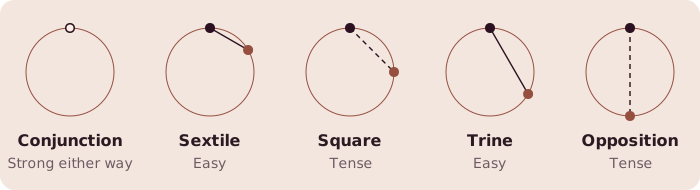
Trines and sextiles describe parts of two charts that cooperate without much effort. These are the places where the two of you tend to fall into step. Read the one-line notes and pick out the ones that match something you have already felt, such as a shared way of laughing or deciding.
Tense connections
Squares and oppositions describe friction. Friction is not a flaw to be fixed. Many pairs find that the tense aspects are exactly where they push each other to grow, or where a recurring disagreement lives. If a tense connection puzzles you, look at which planets it links, then think about when that topic last came up between you.
Strong either way
Conjunctions place two planets almost on top of each other. The effect can be warm or abrasive depending on the planets involved, which is why the list is kept separate from Easy and Tense. Read each note for its own wording instead of assuming a mood.
Orbs and the strongest connections
The closer an aspect is to exact, the louder it speaks. The list of strongest connections is a good place to spend your first few minutes, since it brings up the aspects that carry the most weight in the comparison. The tighter ones usually explain more of what you notice day to day than a long list of loose ones.
Making sense of the four scores
Attraction, talking, feeling and staying are four separate scores, so read them side by side rather than as one verdict. When one score sits clearly above another, open the aspect list and read the one-line notes. The notes give you wording for what you already notice between you. Use the gap to decide which notes deserve your attention first, not to rank the relationship.

Using the wheel and the composite chart
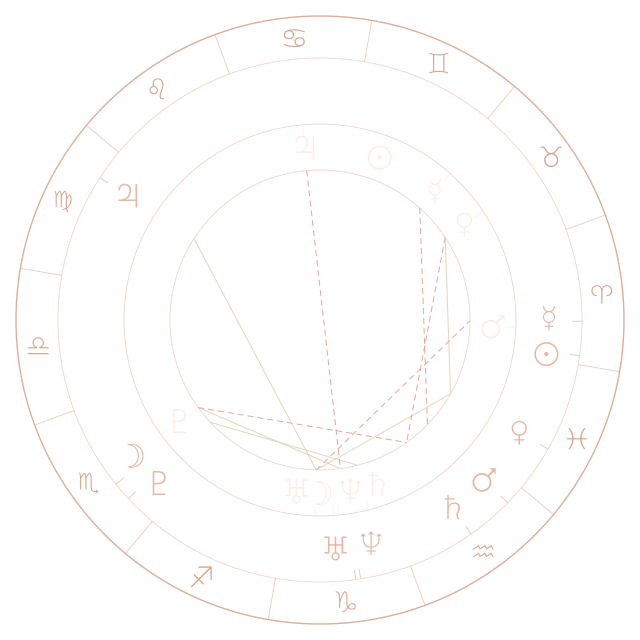
The two-ring wheel shows one person’s planets on the inner ring and the other’s on the outer ring, with lines for the 12 closest aspects. Look for clusters: a planet with several lines to it is involved in many of the connections you just read about.
House overlays need birth times, so this date-only page leaves them out. The composite chart treats the pair as a third chart of its own, so read it as a picture of the relationship itself rather than of either person.
Talking about the result together
If you share the reading with the other person, begin with the Easy list. It gives you both something to agree with before you reach the tense items. Pick one or two notes each that ring true and one that does not, and say why. Disagreement with a note is useful information too.
Treat the numbers as a conversation starter. A note that fits last year may read differently now, and two dates are one lens among many.
When you want to look again
Run the comparison a second time with a different pairing, for example you and a close friend. Putting readings side by side shows which patterns belong to the specific pair and which show up for you in general.
Common questions
Can I check love compatibility with only a date of birth?
Yes. Two birth dates are enough for a full reading of the planet positions on those days, with every aspect listed and scored.
Is this love compatibility calculator by date of birth free?
Yes. You pay nothing for any calculation or for the single-line explanation of each aspect, and you never need to create an account or share an email. Signing in is optional and only matters if you want one reading saved to your account, which you can remove from the results page.
Is this numerology or astrology?
It is not numerology. The calculator uses the Western tropical zodiac and compares the planet positions on both birthdays. The result is built from the aspects between the two charts, each listed with its orb and a one-line plain reading.
What is a good compatibility score?
No single number counts as good. The result gives four scores out of 100, for attraction, talking, feeling and staying, and each describes a different side of a pairing. Read them next to the Easy, Tense and Strong lists rather than as a pass mark.
What does adding a birth time change?
Rising signs and houses need a birth time, which you can add on the main synastry chart page. Without one, Moon connections count at half weight.
Can I compare a parent, a sibling or a friend?
Yes. Switch the result to Friends or family to read the same two charts without a romantic frame. If either person is under 18, Friends or family is the only view available.
Are my birth dates stored or shown in the page address?
Birth dates are never put in the page address, and the calculation runs in your browser. Nothing you enter is sent anywhere until you log in or buy a report, and either step stores it on our servers. A saved reading can be removed from the results page.
What do Easy, Tense and Strong either way mean?
They group the aspects between the two charts. Easy covers trines and sextiles, Tense covers squares and oppositions, and Strong either way covers conjunctions. Each aspect comes with an orb and a one-line plain reading, so you can see what sits behind each count.