Birth Chart Compatibility: How Compatible Are We?
Two birth dates are enough to see how compatible you are: the result gives an overall score out of 100 and separate scores for attraction, talking, feeling and staying. Birth chart compatibility rests on the connections between the two charts, sorted into Easy, Tense and Strong either way, each with a one-line plain reading. Birth time and city are optional extras that sharpen the details.
Your birth chart compatibility is a set of connections between two charts, summed up as an overall score out of 100. With both birth times, a typical random pair lands near 72, and nine in ten fall between 60 and 82. With dates only it is near 68, and nine in ten fall between 58 and 77. A score reads best against the range that fits your case. The connections behind the score tell you where the pair flows easily and where it takes effort.
How to use it
- Enter the first birth date Type the month, day and year for the first person. The cursor moves to the next box when one is full. Add birth time and city if you have them.
- Enter the second birth date Fill in the same boxes for the second person. If a birth time is unknown, tick the box for it and the time and city fields disappear.
- Press the button The calculation runs in your browser and the result opens on a results page. No name, gender, account or email is needed.
- Read the scores, then the connections Start with the overall score and the four category scores, then open the strongest connections and the full aspect list. Switch to Whole Sign houses on the result if you prefer them.
Who looks up a pair of charts, and why
Most visitors arrive with one particular person in mind. Someone a few weeks into dating wants a second way to think about why conversations feel easy but plans feel awkward. A couple planning to move in together wants a shared reference point for a talk they have been putting off. Others check a sibling they argue with, a parent, a close friend or a business partner, simply out of curiosity about why the two of them click or clash.
All of these are reflection, not a ruling. The page works best as a prompt: it hands you specific topics to talk about, instead of a vague feeling.
Getting the birth details ready
The date is the part you cannot skip, so confirm it before you start. If you are unsure about the other person’s birthday, ask them directly rather than guessing. One wrong day gives a different chart.
Birth time is worth a short search. A birth certificate often lists it, and so does the paperwork from a hospital. Parents and older relatives sometimes remember it, and a baby book may have it written down. If the time is recorded to the nearest few minutes, enter it as written. If only “around noon” is remembered, it is usually better to tick the unknown box than to enter a rough guess.
For birth place, type the town where the birth happened and pick the matching line from the list. A larger city nearby is a different place, so choose the town named on the birth record.
Reading the four scores
The overall score is the headline, but the four category scores are where the useful differences sit. Attraction, talking, feeling and staying rarely match each other. A pair with a high score for talking and a lower one for staying, for instance, may enjoy each other’s company easily and still need to be deliberate about long-term routines.
Keep the typical range in mind. With both birth times, most pairs land between 60 and 82, with about 72 in the middle. With dates only, most land between 58 and 77, with about 68 in the middle. A result near the middle is therefore an ordinary one, not a warning. Differences between your categories tell you more than the single number does.
Making sense of the connection lists
Open the strongest connections first. Each one is a single pairing between a planet in one chart and a planet in the other, with a plain one-line reading beside it. Go through them one at a time and ask whether any match something you have already noticed. Often one or two will.
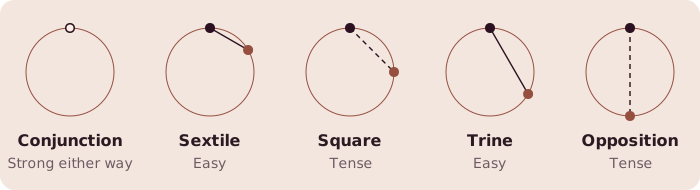
Then look at the three groups. A long Easy list, made of trines and sextiles, shows where the two charts support each other. A long Tense list, made of squares and oppositions, shows where the charts pull against each other, and so where a conversation may be worth having. Strong either way connections are the conjunctions, listed apart from the other two groups.
The orb beside each aspect shows how exact the connection is. A small orb means the two planets sit close to the exact angle, so the connection is more noticeable. A wide orb, close to the limit, is quieter.

Using the result in a real conversation
A result is more useful shared than kept private. Send the other person a few lines from the Easy list and ask whether they recognize them. Pick one Tense connection and treat it as a topic for a calm talk, such as how each of you handles disagreements or time alone.
Friends and family can use it lightly. Two siblings might compare their talking scores and see how well they match their long phone calls. A parent and an adult child might use a Tense connection to name a recurring friction without blaming either person.
Comparing more than one pair
Running the calculator for several pairs shows how scores spread. Check yourself with a partner, a close friend and a relative, and notice how the category scores change from one pair to the next. Seeing the spread across pairs helps set realistic expectations for any single result.
If you later find a birth time, run the same pair again. Rising signs, houses and full-weight Moon connections are added, and the house overlays give you more to compare with what you have already noticed between you.
Common questions
How can I calculate my compatibility based on my birth chart?
Enter your birth date and the other person’s birth date, then press the button. The calculator builds both charts, compares every planet in one chart with every planet in the other, and returns an overall score out of 100. Birth time and city are optional and add rising signs and houses.
Can it analyze romantic compatibility using the full charts, including Moon placements?
Yes. The result lists every aspect between the two charts, with Moon connections included, and sorts them as Easy, Tense or Strong either way. Each carries a one-line reading and its orb. Without a birth time, Moon connections count at half weight because the Moon may be up to about 16 degrees off.
Where can I generate a synastry chart with aspects and house overlays?
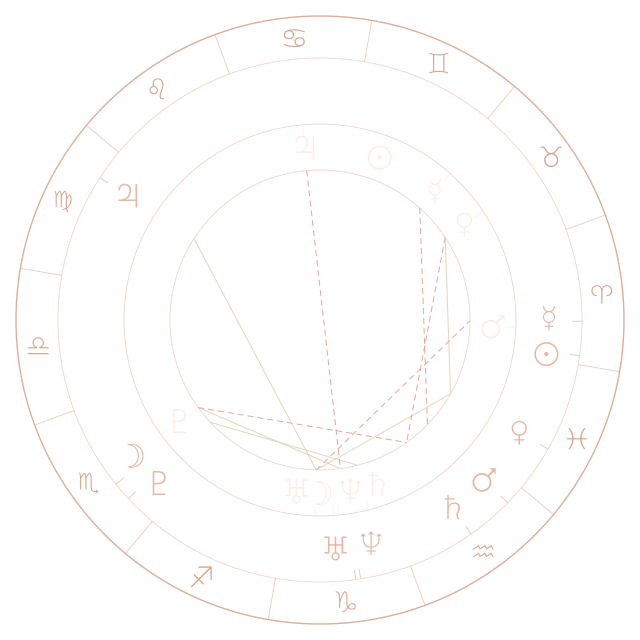
Here, for free. The result shows a two-ring chart wheel, every aspect with its orb, house overlays and a composite chart. Houses default to Placidus, and Whole Sign is an option on the result. House overlays need a time and a city for the person whose houses are being read, not for both people.
How do I read a compatibility birth chart?
Begin with the overall score, then the four scores for attraction, talking, feeling and staying. Next read the strongest connections, then the full list. Easy connections are trines and sextiles, Tense ones are squares and oppositions, and conjunctions are Strong either way.
What two signs do not go together?
No pair of signs is ruled out. The calculator compares complete charts rather than Sun signs alone, and scores for a typical pair sit between 60 and 82 nine times in ten with both birth times, or between 58 and 77 with dates only. A pair that shares few Easy connections may simply show them in other places, such as the Moon.
What do I get free, and is an account needed?
All calculations and the one-line reading of each aspect are free, with no account and no email. The form never asks for a name or gender. Nothing leaves your device until you choose to save it or buy a report, and either one keeps your birth details on our servers. A saved reading can be removed from the results page.
What if I don’t know a birth time?
Tick the box for an unknown time. The calculation still runs, but rising signs and houses are left out and Moon connections count at half weight. Add the time later and run it again for the full result.
Can I check a friend or family member?
Yes. The results switch between Couple and Friends or family. If either person is under 18, only Friends or family is available.